
 English
 اللغة العربية
 Spanish


- Countries of the World
- Cities and provinces
- Complete Cooking Recipe Index
- Prophets' Stories
- List of surahs in the Holy Qur'an
- All Countries of the World
- Population of world countries by country
- Traffic signs in Jordan
- Zip code in Jordan
- List of world capitals
- The story of the cow of the Bani Israel
- International Calling Codes
- Al-Quran Recitations mp3
- List of currencies of the world
- Jordanian Cuisine Guide
- Car Brand Logos and Names
- Country codes names
- World time zones by country
- 6 Evergreen Content Topics
- Country flags of the world with images and names
- List of countries and dependencies by area
- List of countries and dependencies by population
QR Code
Scan the code to visit the page
News
-
 Driving theory test in Jordan Sat, 09 May 2026
Burundi
Official name: Republic of Burundi
Also known as: Repuburika y’Uburundi (Kirundi), République du Burundi (French), Jamhuri ya Burundi (Swahili)
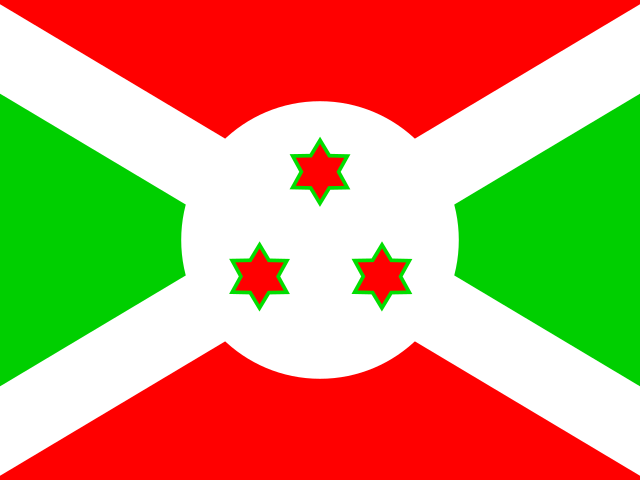
Area of Burundi: 27,834 km² (10,747 mi²) (145th)
Population of Burundi: 14,047,786 (78th) - (2024 est.)
Location: Eastern Africa
Languages of Burundi: Kirundi (official) only: 29.7%, French (official) only: 0.3%, Kirundi and French: 8.4%, Kurundi, French and English: 2.4%, Swahili only: 0.2%, other language combinations: 2%, unspecified: 56.9% (2008 est.)
— note: Data represents only languages read and written by people 10 years of age or older; spoken Kirundi is nearly universal.
Religions of Burundi: Christian 93.9% (Roman Catholic 63.7%, Protestant 25.2% other Christian 4.5%), Traditional faiths 4.3%, Muslim (mainly Sunni) 2.1%, other / none 0.2% (2020 est.)
Ethnic groups in Burundi: Hutu (Bantu) 85%, Tutsi 14%, Twa (Pygmy) 1% (2020 est.)
Currency: Burundian franc (FBu) (BIF)
Calling code: (+257)
Organizations: United Nations
Border countries (3): Democratic Republic of the Congo 236 km, Rwanda 315 km, Tanzania 589 km.
Coastline: 0 km (landlocked)
Administrative divisions of Burundi

18 provinces:
Bubanza, Bujumbura Mairie, Bujumbura Rural, Bururi, Cankuzo, Cibitoke, Gitega, Karuzi, Kayanza, Kirundo, Makamba, Muramvya, Muyinga, Mwaro, Ngozi, Rumonge, Rutana, Ruyigi.
— note: a law was passed in March 2023 reducing the number of provinces to five: Buhumuza, Bujumbura, Burunga, Butanyerera, Gitega, with full implementation by 2025.
Natural resources: nickel, uranium, rare earth oxides, peat, cobalt, copper, platinum (not yet exploited), vanadium, niobium, tantalum, gold, tin, tungsten, kaolin, and limestone. There is also arable land and the potential for hydropower.
This page has been viewed
12232
times
Be the first to comment on this topic!
Comments Restricted
Sorry, adding comments is only available for registered users.
Click here to log in or create a new account