
 English
 اللغة العربية
 Spanish
Al-Milaha fi Maqala
Your Path to Deeper Insight

Product successfully added to your shopping cart
Quantity
Total
There are 0 items in your cart.
There is 1 item in your cart.
Total products
Total shipping
To be determined
Total
- Countries of the World
- Cities and provinces
- Complete Cooking Recipe Index
- Prophets' Stories
- List of surahs in the Holy Qur'an
- All Countries of the World
- Population of world countries by country
- Traffic signs in Jordan
- Zip code in Jordan
- List of world capitals
- The story of the cow of the Bani Israel
- International Calling Codes
- Al-Quran Recitations mp3
- List of currencies of the world
- Jordanian Cuisine Guide
- Car Brand Logos and Names
- Country codes names
- World time zones by country
- 6 Evergreen Content Topics
- Country flags of the world with images and names
- List of countries and dependencies by area
- List of countries and dependencies by population
News
-
 Driving theory test in Jordan Sat, 09 May 2026
QR Code
Scan the code to visit the page
Greenland
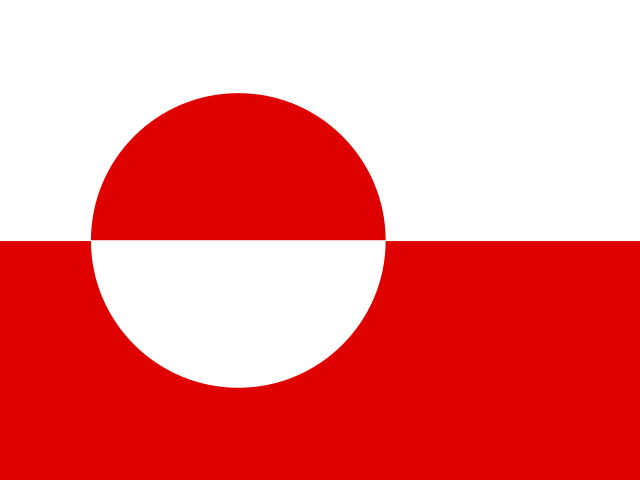
Official Name: Greenland
- Capital of Greenland: Nuuk
- Total Area: 2,166,086 km² (836,330 sq mi) (Rank 12)
- Population: 55,840 (Rank 206) - (2024 estimate)
- Location: Northeast North America, between the Arctic Ocean and North Atlantic Ocean
- Languages of Greenland: Greenlandic, Danish, English, and other languages as needed
- Religions in Greenland: Christianity (Church of Greenland)
- Ethnic Groups in Greenland: Greenlandic Inuit 88.1%, Danish 7.1%, Filipino 1.6%, Other Nordic 0.9%, and Other peoples 2.3% (2024 estimate)
- Currency: Danish krone (DKK)
- Time Zone: UTC±00:00 to UTC-04:00
- Calling Code: (299+)
- Organizations: —
- Border Countries (1): Canada 1,280 m (4,200 ft)
- Coastline: 44,087 km (27,394.4 mi)
- Maritime Borders: Arctic Ocean, Atlantic Ocean
Major Cities and Regions of Greenland

Avannaata, Kujalleq, Qeqertalik, Qeqqata, Sermersooq.
These municipalities include major cities and towns of administrative or touristic importance:
1. Nuuk
- Municipality: Sermersooq.
- Description: Capital of Greenland and its largest city. Located on the southwestern coast of the island, it is the political, cultural, and economic center of the country. Founded in 1728, it includes many important landmarks such as the Greenland National Museum, the Parliament building, and Savior's Church Cathedral.
2. Ilulissat
- Municipality: Avannaata.
- Description: Third largest city in Greenland, located on the western coast. Famous for the Ilulissat Icefjord inscribed as a UNESCO World Heritage Site. The fjord is one of the most active glacial areas in the Northern Hemisphere, producing about 10% of Greenland's icebergs.
3. Sisimiut
- Municipality: Qeqqata.
- Description: Second largest city in Greenland, located on the western coast. Known for its fishing industry and as an important commercial center. The city houses the Sisimiut Museum which displays local history and culture, and serves as a base for hiking and mountain excursions.
4. Qaqortoq
- Municipality: Kujalleq.
- Description: Largest city in southern Greenland. Founded in 1775, it is famous for Greenland's only stone fountain which displays artistic stone sculptures. The city is known for its relatively mild climate compared to the rest of the island.
5. Kangerlussuaq
- Municipality: Qeqqata.
- Description: Located in western Greenland, it is the main air gateway to the island. It was a U.S. airbase during World War II. Known for the nearby Russell Glacier, one of the most accessible glaciers in Greenland.
6. Tasiilaq
- Municipality: Sermersooq.
- Description: Largest city in eastern Greenland. Located on Ammassalik Island and surrounded by mountains and glaciers. Known for its spectacular natural scenery and serves as a base for outdoor activities like boat trips and hiking.
7. Uummannaq
- Municipality: Avannaata.
- Description: Town located on a small island off the western coast. Famous for the distinctive Uummannaq Mountain which resembles a heart and rises 1,170 meters. Serves as a base for traditional seal and whale hunting.
8. Northeast Greenland National Park
- Location: Northeast Greenland (unincorporated area).
- Description: The world's largest national park covering 972,000 km² (about 46% of the island). Established in 1974, it is home to diverse Arctic wildlife such as polar bears, musk oxen, and Arctic foxes. It is also the northernmost national park in the world.
9. Pituffik Space Base (Thule Air Base)
- Location: Northwest Greenland (unincorporated area).
- Description: Former U.S. airbase (known as Thule Air Base). Located about 1,500 km north of the Arctic Circle. Currently used for satellite tracking and scientific research in climate and space studies.
Natural Resources: Coal, iron ore, lead, zinc, molybdenum, diamonds, gold, platinum, niobium, tantalite, uranium, fish, seals, whales, hydropower, potential oil and gas.
Note: Northeast Greenland National Park (Kalaallit Nunaanni nuna eqqissisimatitaq) and Pituffik Space Base (formerly Thule Air Base) in northwest Greenland are unincorporated areas; the national park covers 972,000 square kilometers - about 46% of the island - making it the largest national park in the world and also the northernmost.
Summary: Greenland - The Great Ice Land
Greenland is characterized by being the world's largest island, with its unique icy terrain covering more than 80% of its area. It is divided into 5 municipalities, with its most important cities being Nuuk (capital), Ilulissat (gateway to the ice), and Sisimiut (commercial center). Greenland is famous for its spectacular polar landscapes and giant glaciers, and is home to the ancient Inuit culture and advanced scientific research in polar regions.
Keywords: Nuuk, Ilulissat, Icefjord, Inuit, Greenland Island, Arctic Circle, Glacier.
Major Cities: Nuuk | Ilulissat | Sisimiut | Kangerlussuaq
All rights reserved | gpsarab.com - © 2012-2025
Major Cities: Nuuk | Ilulissat | Sisimiut | Kangerlussuaq
All rights reserved | gpsarab.com - © 2012-2025
This page has been viewed
12836
times
Be the first to comment on this topic!
Comments Restricted
Sorry, adding comments is only available for registered users.
Click here to log in or create a new account