
 English
 اللغة العربية
 Spanish
Al-Milaha fi Maqala
Tu camino hacia más conocimiento

Product successfully added to your shopping cart
Quantity
Total
There are 0 items in your cart.
There is 1 item in your cart.
Total products
Total shipping
To be determined
Total
- Países del mundo
- Ciudades y provincias
- Índice completo de recetas de cocina
- Historias de profetas
- Lista de suras del Sagrado Corán
- Todos los países del mundo
- Población de los países del mundo por país
- Señales de tráfico en Jordania
- Código postal en Jordania
- Lista de capitales del mundo
- La historia de la vaca de los Bani Israel
- Códigos de llamadas internacionales
- Recitaciones del Corán en formato MP3
- Lista de monedas del mundo
- Guía de cocina jordana
- Logotipos y nombres de marcas de automóviles
- Nombres de códigos de países
- Zonas horarias mundiales por país
- 6 temas de contenido "Evergreen" (siempre vigente)
- Banderas de países del mundo con imágenes y nombres.
- Lista de países y dependencias por área
- Lista de países y dependencias por población
Noticias
-
 Examen teórico de conducir en Jordania Sat, 09 May 2026
Código QR
Escanea el código para visitar la página
Bosnia and Herzegovina
Official name: Republic of Bosnia and Herzegovina
Also known as: Republika Bosna i Hercegovina, Република Босна и Херцеговина (Serbo-Croatian)

Area of Bosnia and Herzegovina: 51,209 km² (19,772 mi²) (127th)
Population of Bosnia and Herzegovina: 3,164,253 (136rd) - (2024 est.)
Location: Southeastern Europe
Languages of Bosnia and Herzegovina: None (de jure) Bosnian, Croatian, Serbian (de facto)
Religions of Bosnia and Herzegovina: Islam / Muslim (51.3%), Eastern Orthodox (30.7%), Catholicism / Roman Catholicism (15.4%), No religion / Others (2.6%) (2013 est.)
Ethnic groups in Bosnia and Herzegovina: Bosniaks (50.12%), Serbs (30.83%), Croats (15.43%), Others (2.73%), Not declared/no answer (0.88%).
Currency: Convertible mark (KM) (BAM)Time zone: UTC+1 (CETCentral European Time (CET) is a standard time of Central, and parts of Western Europe, which is one hour ahead of Coordinated Universal Time (UTC). The time offset from UTC can be written as UTC+01:00. It is used in most parts of Europe and in several African countries. CET is also known as Middle European Time and by colloquial names such as Amsterdam Time, Berlin Time, Brussels Time, Budapest Time, Madrid Time, Paris Time, Stockholm Time, Rome Time, Prague time, Warsaw Time or Romance Standard Time (RST).), Summer (DSTDaylight saving time (DST), also referred to as daylight saving(s), daylight savings time, daylight time (United States and Canada), or summer time (United Kingdom, European Union, and others), is the practice of advancing clocks to make better use of the longer daylight available during summer so that darkness falls at a later clock time. The typical implementation of DST is to set clocks forward by one hour in spring or late winter, and to set clocks back by one hour to standard time in the autumn (or fall in North American English, hence the mnemonic: 'spring forward and fall back').) UTC+2 (CESTCentral European Summer Time, sometimes referred to as Central European Daylight Time (CEDT), is the standard clock time observed during the period of summer daylight-saving in those European countries which observe Central European Time during the other part of the year. It corresponds to UTC+02:00, which makes it the same as Eastern European Time, Central Africa Time, South African Standard Time, Egypt Standard Time and Kaliningrad Time in Russia.)
Calling code: (+387)
Organizations: United Nations
Border countries (3): Croatia 932 km, Serbia 357 km, Montenegro 249 km.
Coastline: Adriatic Sea 20 km
Maritime boundaries: Adriatic Sea
Organizations: United Nations
Border countries (3): Croatia 932 km, Serbia 357 km, Montenegro 249 km.
Coastline: Adriatic Sea 20 km
Maritime boundaries: Adriatic Sea
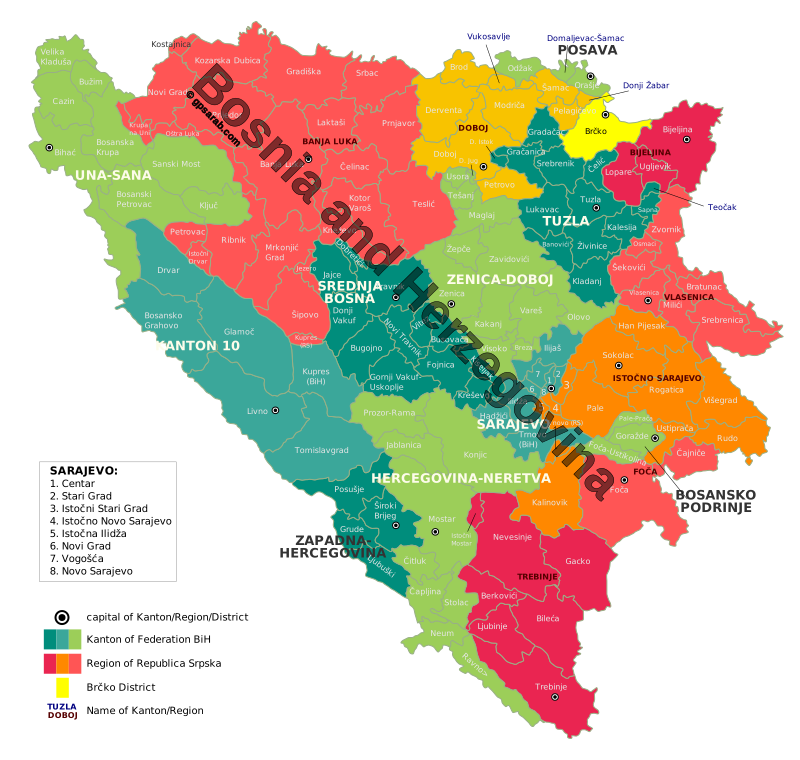
Administrative divisions of Bosnia and Herzegovina
3 first-order administrative divisions:
Brcko District (Brcko Distrikt) (ethnically mixed), Federation of Bosnia and Herzegovina (Federacija Bosne i Hercegovine) (predominantly Bosniak-Croat), Republika Srpska (predominantly Serb).
Regions
- Federation of Bosnia and Herzegovina - with a predominant Bosniak/Bosnian Croat majority population (about 51% of the territory), which includes Northern Bosnia, Central Bosnia, Western Bosnia, Western Herzegovina.
- Republika Srpska (RS) - with a Bosnian Serb majority population (about 49% of the territory), which includes Eastern Srpska, and Western Srpska.
- Posavina – Brčko district.
Cities, towns, and villages
- Sarajevo — the national capital; a cosmopolitan European city with a unique Eastern twist as can be seen in its vast diversity of architectural styles. Home to 400.000 people.
- Banja Luka — the second largest city (200.000 people in wider area), serving as the capital of Republika Srpska, with some historical sights and a rich nightlife.
- Bihać — city on Croatian border, surrounded by an impressive nature.
- Jajce — old royal town in mountainous central Bosnia with 17 meter high waterfall in the city centre and many historical sights
- Mostar — nice old town on Neretva River, symbolized by its medieval bridge. The biggest city in the region of Herzegovina (75.000 people).
- Neum — the only coastal town, with sandy beaches backed by steep hills
- Teslić — а health spa resort with the biggest tourist capacity in the country.
- Tuzla — third largest city (100.000 people in wider urban area) that used to be one of the most significant industrial centers in former Yugoslavia. Has an old town rich with history and monuments to the brutal war too.
- Zenica — the fourth largest city, an important industrial city and one of great economical significance.
Natural resources: coal, iron ore, antimony, bauxite, copper, lead, zinc, chromite, cobalt, manganese, nickel, clay, gypsum, salt, sand, timber, hydropower.
Esta página ha sido vista
12616
veces
¡Sé el primero en comentar sobre este tema!
Los comentarios están restringidos
Lo sentimos, añadir comentarios solo está disponible para usuarios registrados.
Haz clic aquí para iniciar sesión o crear una cuenta nueva